

Prepayment privileges let you put extra money toward your mortgage principal without paying a penalty, which shortens your amortization and may help you become mortgage free years before you plan to retire. Many closed mortgages include prepayment privileges, but the amount and timing depend on your lender and mortgage contract. Used consistently, they cut your total interest and shrink the biggest bill you would carry into your later years.
For many homeowners across Toronto, the GTA and Ontario, the mortgage is the one expense that decides when retirement actually becomes possible. Working toward a mortgage-free retirement means a lighter budget and more breathing room once the paycheques stop. Knowing how these privileges work, and where they fall short, helps you decide how hard to push.
What Are Mortgage Prepayment Privileges?
A prepayment privilege is the amount your lender lets you pay on top of your regular mortgage payments without charging a prepayment penalty. The Financial Consumer Agency of Canada uses the same definition and points out that every lender sets its own limits. Open mortgages let you pay down any amount at any time, while closed mortgages cap what you can prepay each year.
Closed mortgages are popular for their lower rates, so the privileges written into that contract matter. Two mortgages with the same rate can offer very different flexibility. Common features include:
- An annual lump sum allowance based on a percentage of the original mortgage amount, such as 10%, depending on your contract
- A payment increase option that lets you raise your regular payment by a percentage set in your contract
- The option to switch to accelerated weekly or bi-weekly payments
- Timing rules, such as the anniversary date or calendar year when your allowance resets
How Prepayment Privileges Work in Canada
A qualifying prepayment is applied to reduce your mortgage principal, subject to your lender’s terms. That lowers the balance your lender charges interest on, so each regular payment afterward sends a little more toward principal as well. That snowball is why small, steady prepayments often beat one big payment made years later.
There are three main ways homeowners use their privileges, and plenty of people mix all three. The right mix depends on your cash flow, job stability and lender rules. You can test a few scenarios with Karla’s mortgage calculators before committing to anything.
Lump Sum Payments

A lump sum payment is a one-time chunk of money you put against the principal, often from a work bonus, tax refund, inheritance or the sale of an investment. Your contract sets the cap, often as a percentage of the original mortgage amount each year. With a $500,000 mortgage and a 10% allowance, for example, you could prepay up to $50,000 in a year without a penalty, subject to your contract terms.
With many lenders, an unused allowance does not carry forward to the next year. If you skip a year, that room is generally gone for good. A calendar reminder before your reset date helps you use the room while it is there.
Increasing Your Regular Payment
A payment increase lets you raise your regular mortgage payment by a percentage specified in your mortgage contract, such as 10%. The extra portion goes toward principal, so your amortization shortens without a big cheque. For many salaried professionals, it fits a monthly budget more easily than a lump sum.
A smart time to use this feature is right after a raise, the last payment on a car loan or the end of daycare costs. Redirecting that money into the mortgage means you never get used to spending it. Some lenders also let you lower it again later if money gets tight.
Switching to Accelerated Bi-Weekly Payments
Accelerated bi-weekly payments take your monthly payment, split it in half and charge that amount every two weeks. Because there are 26 bi-weekly periods in a year, you end up making the equivalent of 13 monthly payments instead of 12. That one extra payment a year goes toward principal and can take a few years off your amortization.
Regular bi-weekly payments are different, since they simply spread 12 monthly payments across 26 periods with no extra payment built in. Confirm which version you have, since the names look nearly identical on a statement. Accelerated weekly payments work the same way and suit weekly paydays.
Why Paying Down Your Mortgage Faster Can Help You Retire Sooner
Retirement timing often comes down to one question: how much income will you need each month once you stop working? A mortgage payment is usually the largest fixed cost in a household budget, so removing it may lower that number a lot. Reducing your mortgage payment burden can lower the income you need in retirement, and for some homeowners that can support an earlier retirement timeline.
Prepaying can support a retirement plan in several practical ways. Some benefits show up in your budget, while others show up in how secure you feel. Here is what homeowners tend to notice most:
- Less lifetime interest, often tens of thousands of dollars and sometimes much more
- A lower fixed monthly budget heading into retirement
- Less pressure on RRSP, RRIF and pension income to cover housing costs
- More freedom to work part time, help family or travel in your early retirement years
- Peace of mind that the roof over your head is fully yours
What the Numbers Can Look Like: A Simple Example
Picture a $200,000 mortgage at a 6% fixed rate with a 25-year amortization, calculated with semi-annual compounding the way Canadian fixed rate mortgages are. The regular monthly payment works out to about $1,280, and total interest over the full 25 years comes to roughly $183,900. Here is what happens when the same homeowner uses different prepayment strategies:
Payment Strategy | Approx. Time to Pay Off | Approx. Total Interest | Approx. Interest Saved |
Standard monthly payments | 25 years | $183,900 | $0 |
Accelerated bi-weekly payments | About 21 years | $149,900 | $34,000 |
Monthly payments plus $5,000 lump sum each year | About 15 years | $103,800 | $80,100 |
Accelerated bi-weekly plus $5,000 lump sum each year | About 13.7 years | $92,800 | $91,100 |
These figures assume the rate stays at 6% for the entire amortization, which will not happen in real life since rates change at each renewal. As the FCAC explains on mortgage terms and amortization, a longer amortization lowers your payments but raises the total interest you pay. Treat the numbers as an illustration of direction and scale, not a prediction of your own results.
Methodology: Illustration assumes a constant 6% fixed rate with semi-annual compounding, a 25-year amortization and a regular monthly payment of about $1,280. Accelerated bi-weekly payments equal half the monthly payment every two weeks, and each $5,000 lump sum is applied once a year. All figures are rounded estimates.
The Trade-Offs to Weigh Before You Prepay
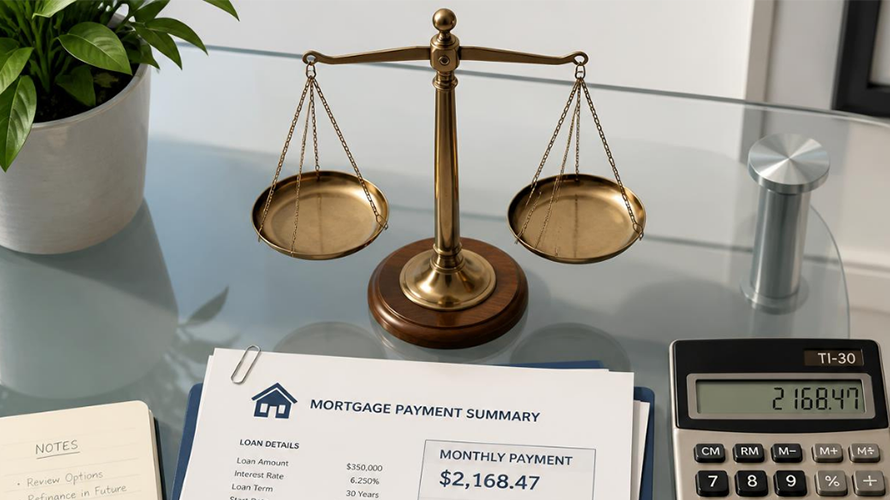
Paying down the mortgage faster is not automatically the right move for every household. Money you put into your home becomes equity, and equity is not easy to get back out without borrowing against it. It helps to weigh the risks alongside the rewards.
Some trade-offs are about access to cash, others about what that money could earn elsewhere. None of them are deal breakers on their own. The main ones to watch are:
- Liquidity: cash tied up in home equity is harder to reach in an emergency
- Opportunity cost: a prepayment gives a relatively certain interest saving at your mortgage rate, which may trail long-term market returns
- Tax advantages: RRSP contributions can lower your taxable income, and TFSA growth is tax free
- Penalty risk: going over your annual allowance on a closed mortgage can trigger a prepayment charge
- Costlier debt: a credit card at 20% costs far more than a 5% mortgage, so debt consolidation may make sense first
Keep an Emergency Fund First
A commonly used planning guideline is to keep several months of essential expenses in an emergency fund before making aggressive mortgage prepayments. A job loss or major home repair can hit without warning, and you do not want to lean on credit cards while your equity sits untouched. A healthy cushion lets you prepay with confidence.
If you need cash later, options like a home equity loan or refinancing may be available, subject to lender qualification and approval. Those come with their own costs and conditions, so treat them as a backup, not a first line of defence. Building savings first keeps you in control of the timing.
Prepaying vs. Investing in Your RRSP or TFSA
A mortgage prepayment produces a relatively certain interest saving based on the rate you would otherwise pay. When mortgage rates are high, that saving can look very appealing next to a bumpy stock market, where returns are uncertain and taxed differently. When rates are low, investing through an RRSP or TFSA may offer more long-term growth potential.
Many homeowners split the difference by contributing to an RRSP and putting the tax refund on the mortgage as a lump sum. That approach captures the tax benefit and still chips away at the principal each year. A financial advisor can help you model the investment side, while a mortgage broker can confirm what your lender’s prepayment rules allow.
Use Your Mortgage Renewal to Reset the Plan
At the end of your mortgage term, you can generally make a lump sum payment without an early break penalty, subject to your lender’s renewal and discharge terms. It is also your chance to pick a mortgage with stronger privileges. Signing the first renewal letter your lender sends may mean missing better terms elsewhere.
Starting the conversation about six months before your maturity date gives you time to compare rates, terms and privileges side by side. Karla’s mortgage renewal review looks at your rate, remaining amortization, payment, prepayment privileges and penalties together. If you want to restructure the loan entirely, mortgage refinancing may also be worth a look, depending on your equity and goals.
When Should You Start Using Mortgage Prepayment Privileges?

The right time to start is once your emergency savings are in place and higher interest debts are under control. After that, a mortgage prepayment strategy works best when it is tied to moments when extra money naturally shows up. Watch for these common triggers:
- Once you have built an adequate emergency fund
- After receiving a work bonus
- After a salary increase
- After getting your tax refund
- After paying off a car loan or other debt
- After receiving an inheritance
- In the months leading up to your mortgage renewal
Acting on even two or three of these triggers each year can help you pay off your mortgage faster without squeezing your everyday budget. Homeowners who start in their 30s or 40s give small prepayments more time to add up to real savings. If you hope to be mortgage-free before retirement, the earlier you build these habits, the more options you tend to have.
How a Toronto Mortgage Broker Can Build Your Prepayment Plan
Prepayment privileges vary widely from one lender to the next, and a bank can only show you its own products. As a mortgage broker in Toronto, the GTA and Ontario, Karla Badillo works with a broader network of banks, credit unions and alternative lenders. She can compare how different mortgages handle lump sums, payment increases and penalties before you sign.
Karla started her career as a financial advisor and has spent more than 13 years in the mortgage industry, so she looks at your mortgage as part of your long-term plan. She will review your rate, amortization, cash flow and retirement timeline, then explain your options in plain language without pressure. Learn more about Karla and her approach, or book a mortgage review to talk through your numbers.
Want to know how many years you could shave off your mortgage? Book your free mortgage review with Karla or call 647-456-6864.
Start Planning Your Mortgage-Free Retirement
Prepayment privileges are one of the simplest tools you already have to pay down your mortgage faster and give yourself more say over when you retire. Lump sums, payment increases and accelerated payments can work together, as long as they fit your cash flow. The real win comes from choosing a mortgage with the right privileges and using them on purpose.
If you live in Toronto, the GTA or anywhere in Ontario, Karla can review your current mortgage and help you map out a realistic prepayment plan. Contact Karla Badillo today or call 647-456-6864 to start your mortgage review. All mortgage financing remains subject to lender qualification and approval.
Have more questions first? Browse the mortgage FAQs or speak with Karla directly.
Frequently Asked Questions
What is a prepayment privilege on a mortgage in Canada?
A prepayment privilege is the amount your lender allows you to pay toward your mortgage principal, on top of your regular payments, without a penalty. It can include lump sum payments, increases to your regular payment or a faster payment schedule. The exact limits depend on your lender and your mortgage contract.
How much can I prepay on my mortgage each year without a penalty?
Many lenders offer annual lump sum privileges based on a percentage of the original mortgage amount. Common examples include 10%, but limits vary by lender and contract, and the same goes for payment increase options. Open mortgages allow any amount at any time, though their rates tend to be higher. Check your commitment letter or ask your broker to confirm your specific allowance.
Is it better to pay off my mortgage early or invest before retirement?
Paying off your mortgage early often makes sense when your rate is high and you value certainty, while investing may suit you better when rates are low and you have a long time horizon. A prepayment produces a relatively certain interest saving at your mortgage rate, while RRSP and TFSA investing offers tax advantages and growth potential with uncertain returns. A financial advisor and a mortgage broker can help you compare the numbers for your situation.
Do accelerated bi-weekly payments really save money?
Yes, accelerated bi-weekly payments can save money because they add the equivalent of one extra monthly payment each year. On a $200,000 mortgage at 6%, that change alone may cut roughly four years off a 25-year amortization and save around $34,000 in interest, based on illustrative figures. Regular bi-weekly payments do not deliver the same savings, so confirm which option you have.
Do unused prepayment privileges carry over to the next year?
With many lenders, unused prepayment privileges do not carry over to the next year. The allowance may reset on your mortgage anniversary or at the start of the calendar year, depending on the lender. A few lenders offer carry forward features, so read your contract or ask your broker.
What happens if I prepay more than my allowance?
If you prepay more than your allowance on a closed mortgage, your lender may charge a prepayment penalty. The penalty calculation depends on your mortgage type and contract, and for fixed rate mortgages it may involve three months’ interest or an interest rate differential. Check your lender’s calculation method before making a large prepayment. Lenders must explain how they calculate these charges, and the FCAC outlines your rights around mortgage prepayment in plain language.
Can I make a large lump sum payment at mortgage renewal?
Yes, at the end of your mortgage term you can generally make a lump sum payment without an early break penalty, subject to your lender’s renewal and discharge terms. That makes renewal one of the best times to put savings or investment proceeds toward the principal. Reaching out about six months before your maturity date gives you time to plan the payment and compare renewal offers.
Should I use my emergency fund to prepay my mortgage?
You generally should not use your emergency fund to prepay your mortgage. Money paid into your home becomes equity, which can be hard to access quickly without borrowing. A commonly used planning guideline is to keep several months of essential expenses set aside before making extra mortgage payments.