

Self-employed individuals can get a mortgage in Canada when they can show lenders steady, qualifying income and a healthy credit history. The paperwork is heavier than it is for someone on a T4 salary. Still, contractors, freelancers and business owners buy homes across Ontario every year.
The real hurdle is usually how your income looks on paper. Smart tax planning can shrink the number a bank sees on your Notice of Assessment. Knowing how lenders read that number is the first step toward a stronger file.
Why Lenders Treat Self-Employed Income Differently
A salaried employee can hand over a pay stub and a job letter. You don’t have an employer to vouch for you, so the lender leans on your own records. That’s why the file gets a closer look. Lenders mainly want answers to a few questions:
- Is the income steady from year to year?
- Is the business still active and likely to keep going?
- Are personal and business taxes paid up with CRA?
- Could the borrower handle payments if rates go up?
Once those boxes are ticked, a self-employed borrower can look just as solid as anyone else. Some look stronger, thanks to good savings and business assets. The key is laying out the full picture clearly.
Self-Employed Mortgage Qualification in Canada: What Lenders Look For

Self-employed mortgage qualification in Canada comes down to four main areas. Each lender weighs them a little differently. The big banks tend to be stricter than credit unions or alternative lenders.
Below is a quick look at each area, starting with the one that trips up most newer business owners. Buying your first place? The first-time home buyers page covers the basics too. Everything here is subject to lender qualification and approval.
Time in Business
Many A lenders prefer about two years of self-employment history, although some programs consider borrowers with less. Two full tax years give the lender a clearer trend to compare. A steady or rising pattern helps a lot.
Newer business owners aren’t automatically shut out. CMHC recommends 24 months of business operation or experience in the same line of work, and it offers added flexibility for recently self-employed borrowers through its CMHC Self-Employed program. For example, a nurse moving from hospital employment into private contracting may have a stronger continuity story than someone entering an entirely new trade.
Tax Documents and Notices of Assessment
Your CRA paperwork is the backbone of the file. Lenders use it to confirm what you earned and what you paid in tax. Most will ask for the last two years of the following:
- T1 General tax returns
- Notices of Assessment (NOAs)
- Statement of Business or Professional Activities (T2125) for sole proprietors
- T2 corporate returns and financial statements if you’re incorporated
Lenders also check that you don’t owe CRA anything. Unpaid personal tax or HST arrears may need to be cleared before closing. Downloading your documents from CRA My Account early can save a lot of back-and-forth.
Proof Your Business Is Real and Active
The lender also wants proof that the business exists and is still bringing in money. Documents vary by business type. Common examples include:
- Articles of incorporation or a master business licence
- GST/HST registration
- Business bank statements, often covering six to twelve months
- Current client contracts or recent invoices
A tidy file here can offset a thinner income history. It shows the underwriter that work is still coming in. Keeping business and personal accounts separate makes this step much easier.
Credit Score and Debt Load
A stronger credit history can improve your access to conventional mortgage options and pricing. Still, lenders look at much more than your score when assessing an application. Some insured programs set minimums, such as CMHC’s requirement that at least one borrower or guarantor has a score of 600, while individual lenders apply their own criteria.
Lenders also review your debt service ratios. These compare your housing costs and total debts against your qualifying income, and CMHC’s maximums sit at a GDS of 39% and a TDS of 44%. Paying down credit cards or a car loan before applying can free up room, and debt consolidation may be worth a look for some homeowners.
Not sure how your numbers stack up? Run a rough estimate with the mortgage calculators, then book a free mortgage review with Karla.
How Lenders Calculate Self-Employed Income in Canada
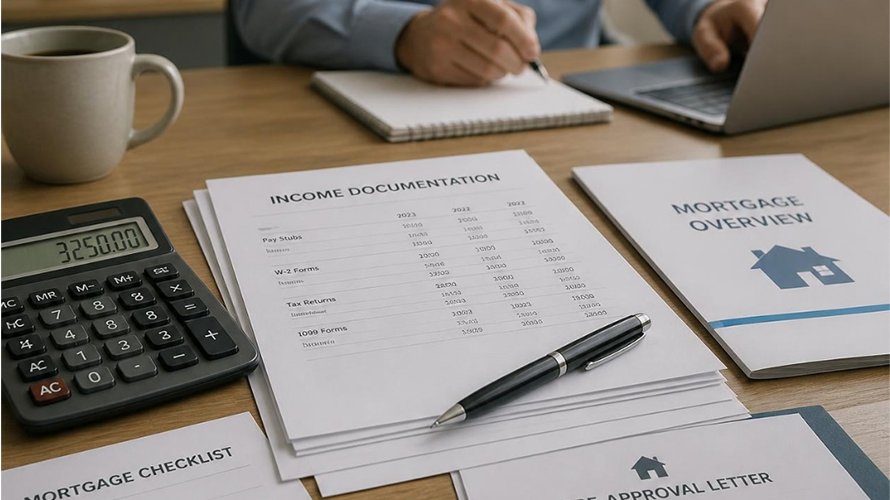
Lenders don’t just grab one number off your paperwork. The figure they use depends on your business structure, the program and the lender’s own underwriting rules. Here are the terms that usually come up:
- Gross business revenue: everything the business brings in before expenses.
- Net business income: what’s left after business expenses.
- Taxable income: the amount on your NOA after deductions, which is often the starting point.
- Add-backs: certain non-cash or eligible expenses a lender or insurer may add back.
- Gross-ups: a percentage increase some programs apply to net self-employed income.
- Salary and dividends: what incorporated owners pay themselves, shown on the T1 and NOA.
- Retained corporate earnings: profit left in the company, which some lenders may partly consider.
- Business deposits: bank activity used to back up income under some programs.
Many lenders review the most recent two years of income, but the calculation can vary by lender, business structure and mortgage program. A decline in the most recent year may affect the income used for qualification.
Sole proprietors and partners are generally assessed on their personal returns. Incorporated owners may be assessed on personal income alone or, with some lenders, on personal and company figures together.
Mortgage Options for Self-Employed Borrowers
There isn’t just one self-employed mortgage. There are several paths, and the right one depends on how your income shows up on paper. Here’s how the main options generally compare.
Option | Often considered when | Typical considerations |
Insured mortgage | Income can be verified under insurer and lender guidelines | Lower down payment may be possible if eligible |
Business-for-self program | Taxable income is reduced by legitimate business expenses | Lender may assess deposits, financial statements and business history |
Alternative lender | Income, credit or business history doesn’t fit conventional criteria | Rates and fees can be higher |
Private mortgage | Short-term or specialized financing needs | Pricing, fees and exit strategy require careful review |
Down payments, rates and fees depend on the lender, your profile, the property, the loan-to-value and market conditions. Treat the table as a general guide rather than a set of rules. Your actual options remain subject to lender qualification and approval.
Mortgage Options for Self-Employed Borrowers
If your NOAs show enough income, you may qualify for a regular insured mortgage. Default insurance from CMHC, Sagen or Canada Guaranty lets eligible buyers put down less than 20%. You may qualify for competitive insured mortgage rates when your income meets the lender’s requirements.
There’s a helpful twist for sole proprietors and partners. CMHC may allow self-employed income to be grossed up by 15%, or have eligible deductions such as business-use-of-home, vehicle costs and capital cost allowance added back. That can lift your qualifying income without changing what you filed.
Business-for-Self Programs
Many business owners write off a lot of legitimate expenses, which lowers taxable income. Business-for-self programs can consider income using alternative documentation and lender-specific underwriting methods when taxable income doesn’t reflect your full financial picture. The lender may review bank deposits, financial statements and business history to support the income used.
The trade-off may be a larger down payment and sometimes a higher rate. The income used also has to pass a reasonability test for your industry and track record. A graphic designer claiming $300,000 on $80,000 of yearly deposits would likely raise red flags with an underwriter.
Alternative (B) Lenders and Private Mortgages

B lenders, such as trust companies, often step in when the big banks say no. They tend to be more flexible with shorter business history, uneven income or past credit hiccups. Rates and fees can be higher, and some borrowers use them for a term or two before moving back to an A lender.
For short-term or equity-based needs, private mortgages may also be an option. Existing homeowners sometimes use a second mortgage or home equity loans to cover business needs or clear debt. Karla explains the full costs and your exit plan before you commit.
How Write-Offs Can Affect Your Borrowing Power
Here’s the catch many business owners don’t see coming. Write-offs reduce the taxable income on your return, which can affect the income a lender uses to qualify you. Some eligible expenses may be added back under specific lender or insurer guidelines, but others usually aren’t. Write-offs that commonly come up include:
- Home office expenses
- Vehicle costs
- Meals and entertainment
- Capital cost allowance on equipment
Planning to buy in the next year or two? Sit down with your accountant and your broker together. You can then weigh the tax you save against the mortgage you’re after.
Down Payment and the Mortgage Stress Test
Down payment rules follow the purchase price. For eligible purchases, the minimum down payment is 5% on the first $500,000, 10% on the portion above $500,000 up to $1.5 million, and 20% at $1.5 million or more. The Financial Consumer Agency of Canada also notes that lenders may ask self-employed buyers for a larger down payment.
You’ll also need to pass the mortgage stress test. Federally regulated lenders generally qualify borrowers at the higher of 5.25% or the contract rate plus 2%, a rule that shows up in both OSFI’s uninsured guidelines and CMHC’s insured requirements. Building that buffer into your budget early helps you shop with realistic numbers.
Tips to Strengthen Your Self-Employed Mortgage Application
A little prep can change how a lender sees your file. Start three to six months before you plan to shop. Here’s a simple checklist:
- File your taxes on time and keep your NOAs handy.
- Pay off any CRA balance owing, including HST.
- Keep business and personal banking separate.
- Build a steady savings trail for your down payment and closing costs.
- Pay down high-interest debt and hold off on new credit.
- Get pre-approved before you start house-hunting.
Already own a home? Your equity may give you more options, from refinancing to a better deal when your mortgage renewal comes up. Karla can review those choices alongside your purchase plans.
Why Work With a Mortgage Broker in Toronto and the GTA
A bank can only offer its own products. A mortgage broker in Toronto and the GTA, Ontario can compare banks, credit unions and alternative lenders in one go. For self-employed borrowers, that extra choice matters.
Karla Badillo brings more than 13 years of mortgage industry experience and began her career as a Financial Advisor. She reviews your whole financial picture, not just one line on your NOA. You can learn more about Karla and her client-first approach.
Ready to Explore Your Self-Employed Mortgage Options?
Being your own boss shouldn’t stop you from owning a home. The right lender, clean paperwork and a clear plan can go a long way. One lender’s no isn’t the final answer.
Karla works with self-employed buyers and homeowners across Toronto, the GTA and Ontario. Book your free mortgage review or call 647-456-6864 to talk it through. For quick answers on other topics, visit the FAQs page.
Frequently Asked Questions
How long do I need to be self-employed to get a mortgage in Canada?
Many lenders prefer about two years of self-employment history. That gives them two NOAs to compare and average. CMHC recommends 24 months in the business or the same line of work, but it offers flexibility for recently self-employed borrowers. Alternative lenders may also consider newer businesses.
What documents do self-employed borrowers need for a mortgage?
Self-employed borrowers usually need two years of T1 Generals and Notices of Assessment. Lenders may also ask for business bank statements, a business licence or articles of incorporation, and current contracts. Incorporated owners should expect to provide corporate financial statements as well. Your broker can confirm the exact list for your chosen lender.
Can I get a mortgage if I write off most of my income?
Yes, you may still qualify through a business-for-self program or an insured program that allows add-backs. These can look at deposits, financial statements and eligible deductions rather than taxable income alone. You may need a larger down payment, and the rate may be higher. The income used must be reasonable for your line of work.
What credit score do I need as a self-employed borrower?
There’s no single credit score that guarantees approval or a particular rate. CMHC requires at least one borrower or guarantor to have a score of 600, and individual lenders set their own criteria. A stronger credit history can widen your options and improve pricing. Lenders also weigh income, debts, down payment and the property.
How much down payment do self-employed buyers need?
For eligible purchases, the minimum down payment starts at 5% on the first $500,000. With verified income and mortgage insurance, you may qualify at that minimum. Business-for-self, alternative and private options often call for more. Lenders can set higher requirements based on your file.
Do self-employed borrowers pay higher mortgage rates?
If your income is fully verified and meets the lender’s guidelines, you may qualify for competitive mortgage rates. Rates and fees can be higher with business-for-self, B lender or private options. A broker can compare offers so you see the full cost, not just the headline rate.
Can I get a mortgage if my business is incorporated?
Yes, incorporated business owners can get a mortgage in Canada. Lenders usually look at the salary and dividends you pay yourself, shown on your T1 and NOAs. Some lenders may also consider a portion of the company’s retained earnings. Expect to provide T2 returns and financial statements.
Can a mortgage broker help if the bank already said no?
Yes, a broker can review why the bank declined and look for lenders that may see your file differently. Each bank follows its own guidelines, and those guidelines vary. One lender’s no isn’t always the final answer. All options remain subject to lender qualification and approval.