
If you ignore your mortgage renewal notice, your mortgage may automatically renew according to the terms your lender set out in that letter, and those terms are not always the strongest ones available to you. Your home is not at risk from a missed signature, and your payments simply carry on under the new term. What you give up is the chance to negotiate your rate, your term and your mortgage features before the clock runs out.
Mortgage renewal is one of the few moments in a homeowner’s life when a single conversation can reset the household budget for years. The Financial Consumer Agency of Canada recommends contacting various lenders and mortgage brokers rather than waiting for the renewal letter to arrive. Knowing your mortgage renewal options ahead of the deadline is what separates a renewal that works for you from one that simply happens to you.
What Happens If You Ignore Your Renewal Notice
Here is the direct answer: your mortgage may renew automatically on the terms your lender outlined, and you lose your window to negotiate. The Financial Consumer Agency of Canada states that if you do not take action, the renewal of your mortgage term may be automatic, and you may not get the best interest rate and conditions. The mortgage does not vanish and the lender does not call your loan.
An automatic renewal may leave you with less opportunity to negotiate your rate, term and mortgage features. That matters because a renewal is a full reset, not just a rate change. The parts most often left unreviewed include:
- A rate and term you did not actively negotiate
- Your amortization, payment frequency and prepayment privileges
- Whether a different lender could offer better mortgage renewal rates for your situation
- Whether higher interest debt could be consolidated while the mortgage is open
Even a modest gap between the offered rate and a negotiated one compounds across a full term. On a mid sized balance that gap is measured in thousands of dollars, not dollars. Reviewing the offer costs you a conversation.
What A Mortgage Renewal Letter Actually Says
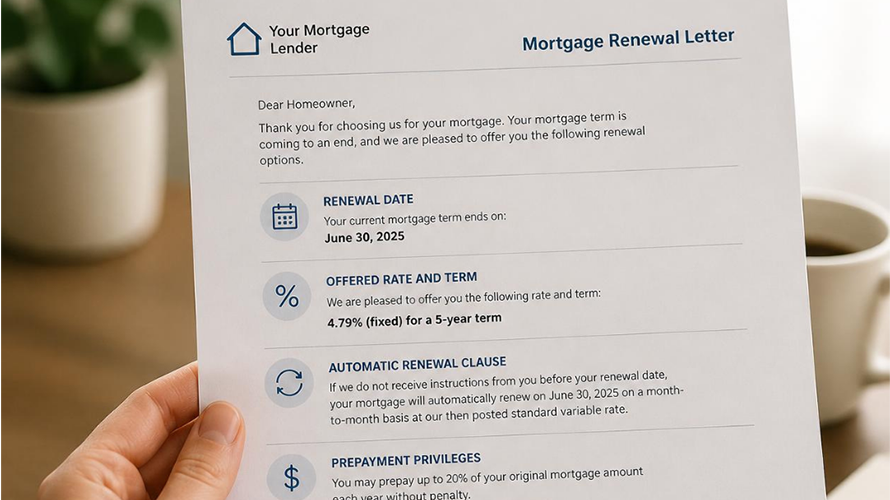
Your mortgage renewal letter, formally called a renewal statement, is a required disclosure document rather than a marketing piece. If your mortgage is with a federally regulated financial institution such as a bank, that lender must give you a renewal statement at least 21 days before your current term ends. It must show the balance or remaining principal at the renewal date, along with the interest rate, payment frequency, term and any applicable charges.
Read it the way a mortgage renewal broker would, which means reading past the headline rate. The clauses that shape your next five years are usually in smaller type. Check for these specifically:
- The renewal date. This is the date every other deadline works backward from.
- The offered rate and term. Compare it against current market pricing, not against your old rate.
- The automatic renewal clause. If your lender intends to renew you automatically, the statement will say so.
- The prepayment privileges. These vary between products more than most homeowners expect.
- Any fees. Discharge, administration or transfer costs belong in your comparison math.
If the letter is hard to follow, that is common and it is fixable. Bring it into a mortgage renewal conversation and have it translated line by line. A second set of eyes often catches a clause worth negotiating.
How Do I Know When My Mortgage Is Due For Renewal?
The usual answer to how do I know when my mortgage is due for renewal is that the letter tells you, and most homeowners rely on exactly that. The problem is that 21 days is the lender’s minimum federal disclosure period, not a recommended starting point for you. FCAC advises starting to shop around a few months before the end of your term.
A better habit is to find the maturity date yourself and set a reminder well ahead of it. It appears in your original commitment letter, on your online banking mortgage summary, and on your annual mortgage payment notice or statement. You can also simply call your lender and ask.
Here is a realistic sense of when to start your mortgage renewal:
- 120 days out: compare mortgage renewal options and ask about a rate hold
- 90 days out: review your credit profile and gather income documents if you are considering switching lenders or refinancing
- 60 days out: submit an application if you intend to move your mortgage
- 21 days out: your renewal statement should have arrived by this point
- Renewal date: the new term begins, whether or not you have signed anything
Running your own numbers first changes the tone of every conversation that follows. Our mortgage calculator produces a payment figure in about a minute. Walking in with a target payment is far more useful than walking in with a question.
Will My Mortgage Automatically Renew If I Do Nothing?

Will my mortgage automatically renew is the question we hear most in renewal season, and the accurate answer is that it may. If your lender plans on automatically renewing your mortgage, it must say so in the renewal statement, and if it does not intend to renew you, a federally regulated lender must notify you at least 21 days before the term ends. Silence on your side generally means the lender’s stated terms take effect.
Automatic does not mean unchanged, and that distinction catches people off guard. Your rate, term and payment can all shift at renewal even though the mortgage itself continues without interruption.
Practical things to watch for:
- Your rate resets to whatever the renewal statement specified
- Some lenders place unsigned files on a short, open or convertible arrangement, which may carry a higher rate
- Your payment may rise or fall depending on the new rate
- Your remaining amortization keeps shrinking, which builds equity faster but can also lift the payment
Convenience is a legitimate reason to accept an automatic renewal. It just should be a decision rather than a default. That is only a fair trade if you have confirmed the offer is competitive.
Will My Mortgage Automatically Renew If I Do Nothing?
A worked example makes the stakes concrete. Take a $500,000 balance with 20 years of amortization remaining on a five year fixed term, using Canadian semi annual compounding. At 5.00% the payment is roughly $3,286 per month, while at 5.50% it is roughly $3,422, a difference of about $136 per month.
Across a full five year term that gap is close to $8,200, and more of each payment goes to interest rather than principal. The exact figures shift with your balance, your starting rate and your remaining amortization. The point holds regardless of the inputs, which is that half a percentage point is not a rounding error.
Recent Bank of Canada reporting adds useful context for anyone renewing in Ontario or elsewhere in Canada:
- In its 2026 Financial Stability Report, the Bank noted that more than 90% of borrowers who renewed in the previous 12 months did so at rates below their original qualifying rates
- Borrowers renewing five year mortgages taken out during the pandemic period were seeing payments rise by roughly 15%
- The share of mortgage accounts more than 60 days behind on payments sat only slightly above the 2018 to 2019 average
- Some borrowers reduced their payment increase by extending their amortization period
If your payment is climbing, there are levers available. Refinancing at renewal may extend amortization, consolidate higher interest debt or improve monthly cash flow, subject to qualification and lender approval.
Will My Mortgage Automatically Renew If I Do Nothing?
The clearest framing for what happens on mortgage renewal is that your term ends, not your mortgage. You are renegotiating the rate, term and conditions attached to the balance you still owe. You are not reapplying for the house, and nothing is being called in.
Once you engage, the mortgage renewal vs refinancing question opens three doors instead of one:
- Renew with your current lender. The fastest route, and still negotiable. FCAC specifically recommends negotiating, since you may qualify for a discounted rate below the one quoted in your renewal letter.
- Move your mortgage renewal to another lender. This may be structured as a straight switch when the mortgage amount and remaining amortization do not increase.
- Refinance. This changes the loan itself, whether to access equity, consolidate debt or restructure the amortization.
One regulatory change made the second door easier for many borrowers. Effective November 21, 2024, OSFI removed the expectation that federally regulated lenders apply the prescribed minimum qualifying rate to uninsured straight switches between federally regulated lenders, provided the loan amount and amortization period do not increase. Lenders still assess debt serviceability using their own underwriting standards, so individual lender policies continue to vary.
Will My Mortgage Automatically Renew If I Do Nothing?
Most missed renewals cost money rather than causing a crisis. A smaller number turn into something more complicated, and the pattern is fairly predictable. Trouble usually begins when the renewal letter arrives during a busy stretch and gets set aside.
These situations generally need more runway than a three week window allows:
- Self employment or a recent job change. Income documentation takes time to assemble properly.
- Credit that has changed since you last qualified. Late payments or high balances can narrow which lenders will consider the file.
- A property whose use has changed. Rentals, added units or business use can move a file into a different lender category.
- Separation or divorce. Removing a name from title usually requires a refinance rather than a simple switch.
- A lender declining to renew. Federally regulated lenders must notify you at least 21 days out, which leaves little time to arrange alternatives.
None of these are dead ends, though they do reward an early start. A broker with access to a wide lender network can approach lenders a single branch does not represent. One lender’s no is not the final answer.
Will My Mortgage Automatically Renew If I Do Nothing?
This is the scenario where the cost of doing nothing climbs fastest. If your credit profile has weakened and your lender renews you automatically, you may accept a weak offer simply because you assume no alternatives exist. That assumption is worth testing before you sign anything.
Canada’s lending market is layered, and federally regulated banks are only one tier of it. Alternative lenders, credit unions and private lenders assess risk differently and read files differently. Approaches that often fit here include:
- A shorter term with an alternative lender while credit is rebuilt, with a view to returning to conventional pricing later
- A second mortgage to clear higher interest balances without disturbing the first mortgage
- A refinance that consolidates debt and reduces the total monthly outlay
Bringing the file forward early matters more here than anywhere else. Options narrow as the calendar tightens. All lending remains subject to qualification, credit review and lender approval.
Will My Mortgage Automatically Renew If I Do Nothing?
Handling this well does not require a spreadsheet or a finance background. It requires a date in your calendar and a short sequence of steps. Add your maturity date to your phone before you close this page.
Then work through the list, starting roughly four months out:
- Confirm your maturity date and current balance
- Ask about a rate hold so market movement cannot work against you
- Compare your renewal offer against several lenders to find the best mortgage renewal rates available to you
- Decide what you are optimizing for, whether that is rate, cash flow, or flexibility
- Review prepayment privileges and penalty language, not only the rate
- Sign with time to spare rather than on the deadline
Working through those six steps puts you ahead of most renewals. A mortgage broker can compare available lender options against your situation, then help you determine whether staying with your current lender or switching makes the most sense for you. If you would rather hand off the legwork, book a renewal review, and you are welcome to start en Español if that is easier.
Do Not Let The Letter Decide For You

Your renewal is a scheduled opportunity to reset the terms of your largest monthly commitment. Your lender’s offer is a starting point rather than a verdict. You are entitled to negotiate it, and you are entitled to take your mortgage elsewhere.
Karla Badillo works with a broad panel of lenders across Ontario and reviews renewal files at no cost to you. Send over your renewal letter and we will walk through what your options look like, including whether staying put is the better move. Get in touch here, run your numbers with our mortgage calculators, or learn more about Karla before you reach out.
NOTE: All mortgage products are subject to lender qualification, credit review and lender approval. Rates, terms and lender policies may change without notice. This content is general information and is not individual financial advice.
Frequently Asked Questions
Can I negotiate my mortgage renewal rate?
Yes. A renewal offer from your current lender is a starting point rather than a final rate. FCAC specifically recommends negotiating with your current lender, noting that you may qualify for a discounted interest rate lower than the rate quoted in your renewal letter. You can also compare offers from other lenders or a mortgage broker before deciding whether to renew or switch, and bringing a competing offer to the table generally strengthens your position.
Can I be denied a mortgage renewal in Canada?
A lender can decline to renew your mortgage, though it is not the common outcome. Federally regulated lenders must notify you at least 21 days before the end of your term if they will not be renewing. Reasons can include missed payments, a change in how the property is used, or the lender stepping back from a particular type of lending. If it happens, you still have time to arrange financing elsewhere, and a broker can approach lenders your current institution does not represent.
Is there a penalty for switching lenders at renewal?
Generally there is no prepayment penalty at maturity, because your term has ended rather than been broken. You may still encounter administrative costs such as a discharge fee, and some transfers involve legal or appraisal fees, which a new lender may or may not cover. The savings from a better rate can exceed those costs, though this depends on your balance and the size of the rate difference. Ask for the full cost breakdown in writing before committing.
How early can I start my mortgage renewal?
Many lenders will discuss renewal roughly 120 days before your maturity date, and a number will hold a rate for you within that window. FCAC advises shopping around a few months before your term ends rather than waiting for the renewal letter. Starting early costs nothing and gives you room to gather documents if you decide to switch. The 21 day statement requirement is a minimum disclosure period, not a planning timeline.
Do I have to requalify when I renew with my current lender?
A straightforward renewal with your existing lender generally does not require you to requalify under the federal mortgage stress test, though lender procedures can vary. Switching lenders or refinancing is a different process and does involve underwriting. Since November 2024, OSFI no longer expects federally regulated lenders to apply the prescribed minimum qualifying rate to uninsured straight switches between federally regulated lenders where the loan amount and amortization do not increase. Lenders still assess debt serviceability on their own standards, so confirm the specific policy before assuming.
What is the difference between a mortgage renewal and a refinance?
A renewal continues your existing mortgage balance under a new term and rate. A refinance changes the loan itself, typically by increasing the amount borrowed or restructuring the amortization. Refinancing requires full qualification and may involve appraisal and legal costs. Renewals are simpler, while refinancing is the appropriate tool when you need to access equity, consolidate debt or reduce monthly cash flow.
What if I miss my renewal date entirely?
Your mortgage does not disappear, and a missed signature alone does not put your home at risk. Your lender will typically apply the terms set out in your renewal documentation, and some place unsigned files on a short, open or convertible arrangement until you sign. You can often still negotiate afterward, although your position is weaker once a new term has begun. Contact your lender or your broker as soon as you notice.
Should I choose fixed or variable at renewal?
That depends on your risk tolerance, your budget cushion and how long you expect to keep the property. A fixed rate provides payment certainty for the term, while a variable rate moves with the prime rate and may cost less or more over time. Shorter terms offer flexibility at the cost of renewing again sooner. There is no universally correct answer, which is precisely why the conversation is worth having before you sign.
Does a mortgage renewal affect my credit score?
A straightforward renewal with your existing lender generally does not involve a new credit inquiry. Switching lenders or refinancing does involve a credit check, which may cause a small, temporary movement in your score. Multiple mortgage inquiries made within a short period may be treated as rate shopping by some credit scoring models, but the exact treatment depends on the credit bureau and the model used. For most homeowners, the long term effect of a better rate outweighs a brief score movement.