
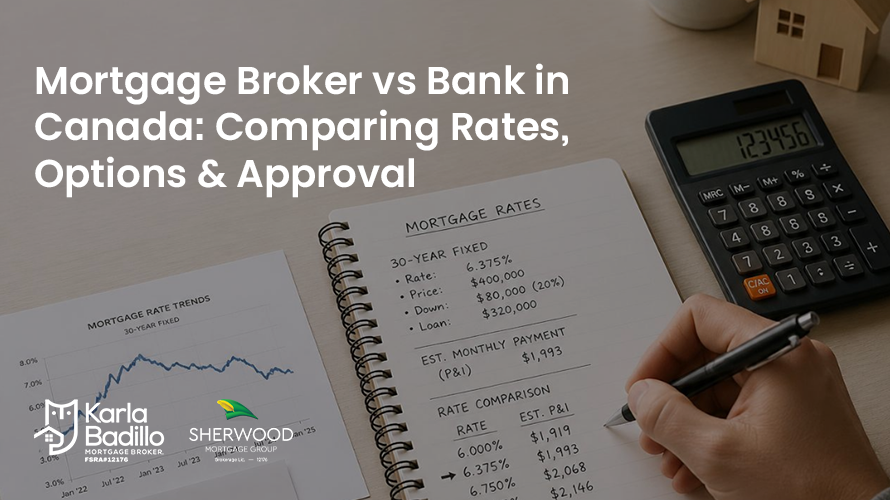
A mortgage broker in Canada will often get you a better rate than a bank, because a broker shops your application across many lenders while a bank branch can only quote from its own shelf. Banks price to protect the margin on clients they already have. Brokers price to win the deal, and that is a different starting point.
The gap is not automatic and it is not always dramatic. A strong borrower with a long branch relationship can sometimes get a sharp exception rate without leaving the building. The better question is which channel puts your particular file in front of the most lenders, and for most Canadians, that is a licensed independent mortgage broker in Ontario.
Understanding Mortgage Broker vs Bank
A mortgage broker is an independent licensed professional who submits your file to several lenders and brings back competing offers. A bank employee works for one lender and sells that lender’s products. Both are regulated and both can be excellent, but only one of them can walk away from a lender who says no.
The practical difference shows up in three places: how many lenders see your file, how flexible the products are, and what happens when your situation is not textbook. Self-employed income, rental income, bruised credit, and a short employment history all get read differently from one lender to the next. That is the thinking behind a phrase most brokers live by, which is that one lender’s no is not the final answer.
- Lender access: A broker may work with chartered banks, monoline lenders, credit unions, trust companies, and private lenders. A branch offers one product shelf.
- Cost to you: On standard residential deals the lender usually pays the broker, so there is typically no direct fee to you. Bank compensation is already built into the quoted rate.
- Credit inquiries: In many cases, a broker can use a single credit report when submitting your application to multiple lenders, reducing the need for separate credit pulls. Ask your broker how your application will be submitted.
- Product depth: A lenders, B lenders, and private options can all be discussed in one conversation.
- Advice: A broker is not carrying internal sales targets on chequing accounts, credit cards, or mutual funds.
What a Mortgage Broker Actually Does

A licensed broker gathers your income, credit, and property documents, then packages that file the way each individual lender wants to read it. Presentation matters far more than most borrowers expect. Two nearly identical applications can get two different answers depending on how the income is explained and which underwriter receives it.
From there the broker negotiates rate and terms, requests exceptions when the file supports one, and manages the paperwork through to funding. A good broker will also tell you which products to avoid, not just which one has the lowest number on the page. You can read more about Karla Badillo’s background and industry experience on the About Karla Badillo page.
How Mortgage Brokers Get Paid in Canada
On most standard residential mortgages, the lender pays the broker a finder’s fee once the deal funds. That fee does not come out of your down payment and is not tacked onto your rate. It is an acquisition cost the lender would otherwise spend on branch staff, rent, and advertising.
Fees can apply on alternative or private deals, and a licensed broker must disclose them to you in writing before you commit to anything. Ontario mortgage brokerages are licensed and supervised by the Financial Services Regulatory Authority of Ontario, which sets the disclosure and suitability standards brokers work under. Ask for the fee disclosure early so nothing surprises you at the lawyer’s office.
What Your Bank Offers, and Where It Comes Up Short
Banks are convenient, familiar, and genuinely fast on straightforward files. If your income is salaried, your credit is clean, and you have twenty percent down, a branch may approve you in days. Relationship pricing is real too, especially for clients holding significant deposits or investments at the same institution.
The limits appear the moment your file needs flexibility. A branch advisor works from a discount grid with limited discretion, and once you fall outside it the answer is usually a decline rather than a referral to a lender who would say yes. Borrowers turned away at a branch often still find a workable path through alternative lenders or private mortgages, subject to lender qualification and approval.
The Renewal Letter Problem

Most Canadians renew by signing the letter their bank mails out before the term ends. That letter rarely holds the sharpest rate the same bank would hand a new client at the door. Lenders count on inertia, and inertia usually wins.
Since late November 2024, borrowers switching an uninsured mortgage to a new federally regulated lender at renewal, without increasing the balance or extending the amortization, are generally exempt from qualifying again under the stress test. That single change removed a real barrier to shopping for your renewal. Running your numbers first with the mortgage renewal tool takes a few minutes and can be worth considerably more than that.
Where the Rate Difference Actually Shows Up
The headline gap between broker and branch pricing is often modest, sometimes fifteen to thirty basis points on a five-year fixed. On a $600,000 mortgage, twenty basis points is roughly $1,200 in extra interest per year. Stretch that across a full term and small numbers stop looking small.
The bigger difference is usually in qualification rather than the quoted rate. A broker may place a file with a lender who accepts your income structure at ordinary A pricing, while a branch pushes that same borrower toward a costlier product or declines outright. The rate matters, but the rate you actually qualify for matters more.
- Monoline lenders often price aggressively because they carry no branch network to fund.
- Credit unions are provincially regulated and can apply their own qualification rules.
- Some lenders discount a specific term, such as the three-year fixed, to hit a funding target.
- Insured mortgages, with less than twenty percent down, generally carry lower rates than uninsured ones because default insurance covers the lender’s risk.
- Posted rates are sticker prices almost nobody pays, yet some lenders still use them to calculate penalties later.
- Choosing between a fixed and a variable mortgage comes down to your risk tolerance, your budget, and where you expect rates to go next. A broker can price both across multiple lenders instead of showing you one bank’s two options.
Where the Rate Difference Actually Shows Up
A large share of Canadian borrowers break a five-year term early, almost always because life changed rather than because they planned it. Job relocations, separations, growing families, and equity takeouts all end terms ahead of schedule. The penalty formula buried in your commitment letter can cost thousands more than the rate you saved.
A no-frills rate often comes with restrictions that surface at the worst possible moment. Before chasing the lowest number, compare the terms below across every quote you receive.
- Prepayment penalty: Three months of interest is standard on a variable. Fixed terms often use an interest rate differential, and lenders calculate that differential very differently from one another.
- Prepayment privileges: Check the annual lump-sum percentage and the payment increase allowance.
- Portability: Can the mortgage move to a new property without penalty, and how many days do you get to close the replacement purchase?
- Charge registration: A collateral charge can make switching lenders at renewal more expensive, since it may require a new legal registration.
- Refinance flexibility: Some deeply discounted products block refinancing entirely until the term ends, which can limit access to home equity loans when you need them.
How the Stress Test Changes the Math
Every federally regulated lender must qualify uninsured borrowers at the greater of the contract rate plus two percent, or 5.25 percent, under the minimum qualifying rate set by OSFI. The test does not change the payment you make. It changes the size of the mortgage you are permitted to carry.
Some lenders that are not federally regulated may use different qualifying rules, which can create additional options for certain borrowers. This is why some borrowers who do not qualify with a bank may still find a realistic option elsewhere.
A broker knows which lenders sit inside that rule and which sit outside it, and can point you toward a path that fits. Where a gap remains, arrangements such as second mortgages may help, subject to lender qualification and approval. Policy rates and lender pricing shift regularly, so it is worth checking current Bank of Canada guidance before you lock anything in.
Who Should Use a Broker, and Who Might Be Fine at the Bank

Brokers add the most value when a file has moving parts. Self-employed borrowers, commissioned salespeople, newcomers to Canada, landlords with several properties, and anyone rebuilding credit usually see more options through the broker channel. The same goes for borrowers who want a real comparison instead of one quote.
A branch can be a perfectly reasonable fit for a salaried buyer with clean credit, steady employment, and a deep existing relationship at that institution. Even then, a second quote costs nothing and gives you room to negotiate. Plenty of clients bring a bank offer to a broker purely as a sanity check, and mortgage refinancing conversations often begin the same way.
- Your income comes from self-employment, contract work, or commission.
- You were declined, or approved for noticeably less than you expected.
- Your credit picked up some bruises over the past few years.
- You are renewing soon and want more than one offer on the table.
Questions to Ask Before You Sign Anything
The best protection against a bad mortgage is a short list of blunt questions. Put them to your broker and to your banker, then compare the answers. Anyone who dodges them is telling you something useful.
Write the answers down as you go. Commitment letters run long, and the terms that matter most are rarely on page one. If a lender will not put an answer in writing, treat that as information.
- What is the rate, the term, and the amortization?
- How is the prepayment penalty calculated, and which rate is used in that calculation?
- What are the annual lump-sum and payment increase privileges?
- Is the mortgage portable, and for how many days?
- Is the charge registered as a standard charge or a collateral charge?
- Who pays the compensation on this deal, and are there any fees to me?
- How long is the rate hold period, and what happens if rates drop before closing?
If you would rather compare offers before signing anything, Karla Badillo can review your current mortgage or your purchase scenario and show you how multiple lenders stack up. There is no obligation and no cost to get a second opinion. Request a free mortgage review.
Frequently Asked Questions
Do mortgage brokers in Canada charge borrowers a fee?
On most standard residential mortgages the lender pays the broker, so the borrower pays nothing directly. Fees can apply on alternative, private, or complex files, and a licensed brokerage must disclose those fees in writing before you commit. Ask for that disclosure at the start rather than at the signing table.
Can a mortgage broker really get a lower rate than my bank?
Often yes, because brokers place volume with lenders who price competitively to win that business. The savings are usually measured in basis points rather than whole percentage points, though on a large balance those points add up. The bigger advantage is access, since a broker can move a file that one lender declines. Rates depend on your credit, income, down payment, and property, and remain subject to lender qualification and approval.
Does shopping through a broker hurt my credit score?
A broker normally pulls your credit once and sends that single report to multiple lenders, so your bureau shows one inquiry instead of several. Applying separately at four or five banks can leave a string of inquiries in a short window. Ask your broker to confirm how your file will be submitted before anything is pulled.
Are broker lenders I have never heard of actually safe?
Monoline lenders, trust companies, and credit unions are regulated financial institutions, and many fund mortgages only through the broker channel. They carry no branch network, which is part of why their pricing can be sharper. Your mortgage is registered against your property the same way it would be with a large bank. Your broker should explain who the lender is, how servicing works, and what happens at renewal.
Can I use a broker if I already have a mortgage with a bank?
Yes, and it is one of the most common reasons Canadians reach out. A broker can review your current terms, calculate the penalty for breaking early, and weigh that cost against what a switch or refinance may save. Sometimes the math says stay put until renewal, and a good broker will tell you so plainly.
Do I need to pass the stress test again when I switch lenders at renewal?
Since late November 2024, uninsured borrowers switching to a new federally regulated lender at renewal are generally exempt, provided the balance does not increase and the amortization is not extended. Change either of those and the qualification rules apply again. Credit unions and private lenders operate under different rules. Confirm your own situation with a licensed broker, since eligibility depends on how the original mortgage was set up.
Is the lowest rate always the best mortgage?
No, and this is where borrowers most often get caught. A rate ten basis points lower may carry a punitive penalty formula, weak prepayment privileges, or a restriction that blocks refinancing until the term ends. If you break the term early, and many Canadians do, those terms can cost far more than the rate saved.
Compare Your Options Before You Commit
If you are buying, renewing, or just want to know how your current mortgage stacks up, one short conversation beats another hour of online research. Karla Badillo reviews your numbers, explains the trade-offs in plain language, and shows you what several lenders may offer. There is no obligation and no cost to talk.
Book a free, no-obligation consultation through the contact page or call 647-456-6864 to get started. You can also browse the mortgage FAQ page for straightforward answers to the questions clients ask most. One lender’s no is not the final answer, and finding out what else is possible costs you nothing.